
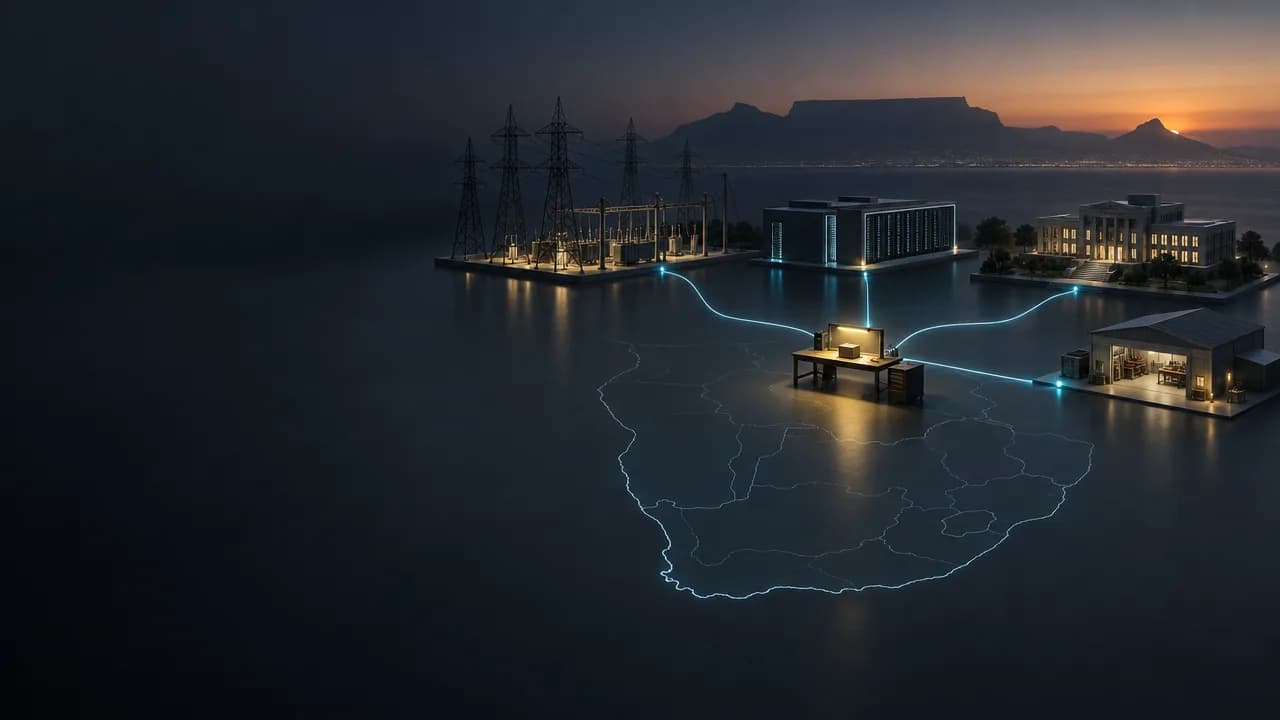
This week about 300 South Africans from government, business, universities and research institutions are in Silicon Valley with the President. ITWeb reported on 18 November 2026 that the delegation includes 27 postgraduate students specialising in artificial intelligence (AI) and about 24 South African start-ups, and that participants are expected to present action plans to the President within 90 days. The small business minister put the problem plainly: "Most governments pay a lot in education, but they do not get a return on investment."
That sentence is the subject of this article. A research result, a talented postgraduate or a promising prototype is not yet a business. Between the laboratory and a customer who pays a second time sits a stretch of work that universities do not fund, investors do not want to pay for, and buyers do not know how to procure. We call it the commercialisation valley. The 90-day plans will be judged by whether they cross it.
What the visit is, and what it is not
The official programme is worth reading before anyone draws conclusions. The government's notice of the working visit (published 12 November 2026, checked on 18 November 2026) describes a visit to California from 15 to 21 November with eight ministers, senior officials, business leaders, start-up founders, small and medium-sized enterprises, students, academics, researchers and legal and regulatory experts. It lists eight tracks, including higher education and skills, small business and innovation, and science and research, and a gathering themed "Building the African AI Economy: Infrastructure, Investment and Innovation". The Presidency's arrival statement frames the purpose as learning about the global AI ecosystem and positioning South Africa as a competitive AI hub, while protecting digital sovereignty and data protection.
Two cautions follow. First, the delegation figures (300, 27 and about 24) come from ITWeb's report; the official notices we checked do not give numbers. Second, a learning visit produces contacts and intent. It does not produce customer evidence. Treat any announcement that follows as stage 1 or 2 on the ladder below until a buyer has paid for an outcome.
Eight stages from result to repeat revenue
Commercialisation is a sequence of decisions, each of which produces a different kind of evidence. Skipping one usually means paying for it later.
| Stage | The decision | Evidence that it is done |
|---|---|---|
| 1. Research result or capability | Is there a result someone else could use? | A reproducible result, documented limits |
| 2. Problem and buyer discovery | Who has the problem, how often, and who pays? | Observed workflow, a named economic buyer, a baseline |
| 3. IP, data rights and team | Who owns what, and who will do the work? | Written rights position, data access terms, committed team |
| 4. Prototype with real constraints | Does it work on the buyer's data, systems and rules? | Results on real data inside the buyer's environment |
| 5. Paid proof of value | Will the buyer pay for an operational outcome? | A paid test against the baseline, with an owner for scale |
| 6. Product and operating model | Can it be supported, secured and sold without the inventor? | Support model, cost per unit of work, release process |
| 7. Repeat sale | Does a second buyer need the same thing? | A second paid deployment with less custom work |
| 8. Export, licensing or scale capital | Can it grow beyond the founding market? | Unit economics that survive a new market or licensee |
The Opportunity Card evidence ladder in Part 1 runs alongside this table. Stages 1 to 4 correspond to stated problems, observed workflows and technical feasibility. None of them is market traction.
Why the valley exists
The two banks of the valley have owners. Universities, research councils and postgraduate programmes support stage 1. Sales teams, channel partners and growth investors support stages 7 and 8. The middle has no natural owner, and each stage in it asks for a skill the previous one did not need.
Problem access. Researchers rarely see a buyer's daily workflow. A model that is accurate on a public dataset may solve a problem nobody in the target organisation has budget for. Stage 2 is the cheapest stage and the one most often skipped.
Rights. In South Africa, intellectual property (IP) that comes from publicly financed research falls under the Intellectual Property Rights from Publicly Financed Research and Development Act 51 of 2008, which requires institutions to run offices of technology transfer and to disclose such IP. AI adds a second layer: the rights to training data, to the buyer's data during a pilot, and to anything the model produces. A start-up that cannot answer "who owns what" cannot sign a paid pilot with a careful buyer. This is general information, not legal advice; take advice on your specific position.
Engineering for real systems. A research prototype runs on a laptop with clean data. A buyer's environment has identity, network rules, old systems, personal information and an operations team that will be called at 2am. The gap between the two is engineering work, not research.
Procurement and distribution. Large South African buyers, public and private, procure through supplier onboarding, security reviews and contract templates written for established vendors. A start-up with a good result and no route through procurement stalls at stage 5.
Patient capital. Stages 3 to 6 take time and produce little revenue. Grant funding usually ends at stage 1 or 2; growth capital usually starts at stage 7.
What does not count as evidence
The series brief has a guardrail for this article, and it is worth stating as a rule: patents, prototypes, accelerator places and investment are not proof of customer value. Each one is useful. None of them shows that a buyer's work got better and that the buyer paid for it.
| Signal | What it shows | What it does not show |
|---|---|---|
| Patent filed or granted | A protectable invention | That anyone needs it, or will pay |
| Working prototype | Technical feasibility on some data | Performance on the buyer's data and systems |
| Accelerator or delegation place | Selection by a programme | Market demand |
| Investment raised | An investor's belief | Customer value; it may only fund the search |
| Letter of intent | Interest | Budget, authority or a decision |
| Paid proof of value against a baseline | An operational outcome a buyer valued | Repeatability (that needs stage 7) |
Business models that can carry a team across
There is no single route. The model has to match the stage and the team.
| Model | Fits when | Main risk |
|---|---|---|
| Paid discovery sprint with a buyer | Stage 2 is unproven and the buyer has a named problem | Discovery without a decision gate |
| Joint productisation sprint (university, start-up, buyer) | A result exists and a buyer will host a real-constraint test | Unclear IP terms stall the contract |
| Licence to an established vendor | The capability is a component, not a product | Weak differentiation, small royalty |
| Forward deployed engineering pod | The product must be shaped inside the buyer's environment | Embedded work turns into staff augmentation |
| Channel or revenue-share partnership | A partner already holds the buyer relationship | Margin erosion and blurred accountability |
Forward deployed engineering, where engineers work inside the customer's environment and feed what they learn back into the product, is a natural fit for stages 4 to 6. Part 9 treats it as a commercial model in its own right.
Opportunity Card: a university-to-industry productisation sprint
This card uses a labelled composite: a university AI research group, a small start-up formed by two of its graduates, and a mid-sized South African insurer with a documented claims-triage problem. It describes no real organisation. The card template and the five qualification gates are in Part 1.
| Field | Composite entry |
|---|---|
| Opportunity name | University-to-industry AI productisation sprint |
| Sector | Financial services (insurance), with a university partner |
| Problem | A research result in document classification has no tested route into a buyer's claims workflow |
| Affected people | Claims assessors, the research group, the graduate founders |
| Economic buyer | The insurer's head of claims operations |
| Current workaround | Manual triage of incoming claim documents; the research sits in a thesis |
| Trigger for change | Claims backlog growth and a public commitment to turn research into business |
| Desired outcome | A tested decision on whether the capability improves triage on real claims |
| Baseline metric | Current triage time and misrouting rate, measured over four weeks before the test |
| Target metric | Agreed with the buyer before the test; not set by the research team |
| Required data | A de-identified sample of claim documents under a written data-access agreement |
| Required integrations | Read-only access to the document store; no write access to the claims system |
| Decisions or actions | The model suggests a route; an assessor accepts or overrides it |
| Human authority | Assessors keep every routing decision during the test |
| Delivery model | Twelve-week productisation sprint with an embedded engineer |
| Revenue model | Buyer pays a fixed fee for the sprint; licence or subscription only after stage 5 |
| Key dependencies | IP agreement with the university, buyer security approval, a named supervisor |
| Material risks | Rights dispute, personal information exposure, a test that never gets an owner for scale |
| Smallest paid test | The sprint itself, with a go or no-go decision at week twelve |
| Evidence required | Override rate, triage time against baseline, assessor feedback, cost per document |
| 90-day next action | Sign a three-party term sheet covering IP, data and the decision gate |
| Status | Hypothesis |
The gate most likely to fail is not technical. It is "buyer and route": if the claims head cannot buy a sprint from a two-person start-up through procurement, the card stops there, regardless of how good the model is.
What 90 days should produce
The delegation's 90-day plans are a useful forcing device. Here is what a credible plan for one research capability would contain at day 90:
- A named problem owner at a buyer, with a baseline measured in their environment.
- A written rights position covering the research IP, the training data and the buyer's data.
- A prototype tested on the buyer's data, with its failure cases documented.
- A signed, paid proof of value with a decision date and an owner for scale.
- A list of what the product still needs to be supportable without its inventors.
If a plan at day 90 contains only meetings held, memoranda signed and events planned, it has not left stage 1.
The South African version
Three local conditions shape the valley.
- Infrastructure exists; demand discovery lags. The President noted, as reported by ITWeb, that South Africa hosts almost 70% of the continent's data centres. We have not independently verified that figure. Either way, compute is rarely the binding constraint at stages 2 to 5. Problem access and procurement are.
- The buyer base is concentrated. A handful of banks, insurers, retailers, mines and state entities hold most large budgets. A start-up that wins one of them may not find a second domestic buyer quickly, which makes stage 8, export or licensing, an early design question.
- Work-integrated learning is already on the agenda. The higher education minister's discussions in California covered work-integrated learning and research collaboration. A productisation sprint is a form of work-integrated learning for postgraduates. Part 4 takes that thread further.
Checklist for a research team with a buyer in sight
- Write down the problem in the buyer's words, not the paper's.
- Name the economic buyer and confirm they control a budget.
- Measure a baseline before you build anything new.
- Settle IP, data and output rights in writing before the pilot starts.
- Test on the buyer's data, inside their constraints, and record what fails.
- Ask for payment for the proof of value, however small.
- Agree the decision date and the owner for scale before the test starts.
- Count paid outcomes, not patents, prototypes or meetings.
Next: Part 4, Skills that lead somewhere. Previous: Part 2, AI runs on electricity. All parts are on the series page.
How CloudNala can help
CloudNala helps research groups, start-ups and enterprise buyers cross the commercialisation valley together. We run paid discovery with the buyer to measure the baseline, set out the rights and data questions a lawyer needs to settle, design a prototype test inside the buyer's real constraints, and write the decision gate and success measures for a paid proof of value. You leave with an Opportunity Card that both sides have signed off and a 90-day plan that ends in a decision.
Work with CloudNala
CloudNala helps organisations move from technology ambition to practical execution across cloud, AI, data, platform engineering and digital services.
Whether you are exploring AI, modernising your cloud environment, building a public-sector digital service, or turning an idea into a working MVP, we can help you shape the roadmap and deliver the next step.
Plan an AI Productisation Sprint or write to us at consult@cloudnala.co.za